

Introduction
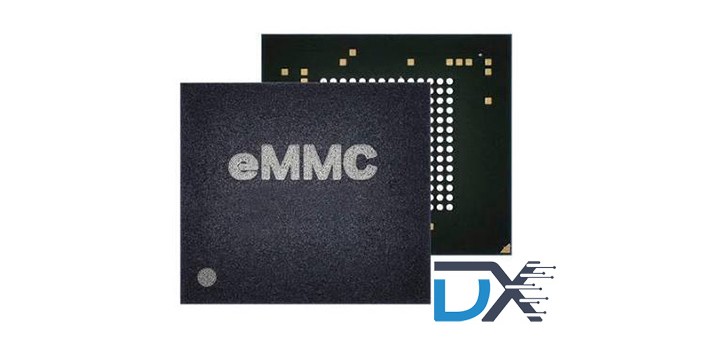
eMMC, short for Embedded Multi-Media Card, is a type of embedded flash storage that combines NAND flash memory and a flash controller in a single package. It is widely used as built-in storage in electronic devices such as smartphones, tablets, smart TVs, industrial equipment, and other embedded systems.
As electronic devices become smaller and more connected, storage needs to be compact, reliable, and easy to integrate. This article explains what eMMC is, how its architecture and working principle operate, its main features and generations, where it is used, and the differences between consumer and industrial eMMC.
What is eMMC?
eMMC stands for Embedded Multi-Media Card. It is an embedded storage solution that combines NAND flash memory with a dedicated controller in one package. The controller manages many flash-memory operations, allowing the host processor to communicate with the storage through a standardized interface instead of directly managing NAND flash.
One of the main reasons eMMC became widely used is its simple and standardized design. Because the NAND flash and controller are integrated into one package, manufacturers can reduce storage-management work on the host processor and simplify hardware and software development.
The main advantage of eMMC is integration. By combining several storage functions into one compact package, eMMC can save board space, reduce design complexity, and provide a practical storage solution for mobile and embedded devices.
Architecture of eMMC
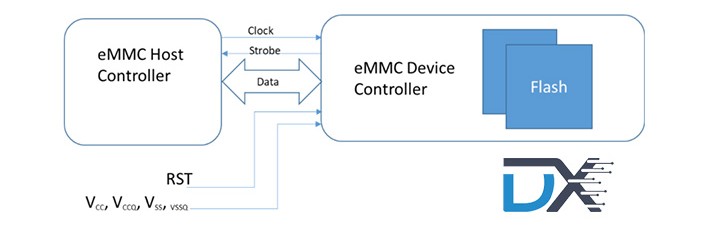
An eMMC device can be understood through three main parts:
- NAND Flash Memory
NAND flash is the non-volatile memory inside an eMMC device. It stores data even when power is removed. Different eMMC products can use different NAND technologies and configurations depending on their capacity, performance, endurance, and application requirements.
- Flash Memory Controller
The controller manages the NAND flash and handles many operations that would otherwise need to be managed by the host processor. Important functions include error correction, wear leveling, flash management, and read/write optimization.
ECC (Error Correction Code): Helps detect and correct certain data errors to improve data reliability.
Wear Leveling: Distributes write and erase operations across the flash memory to help manage NAND wear.
Flash Management: Controls how data is stored, moved, and accessed inside the NAND flash.
- Host Interface
The host interface provides the communication path between the eMMC and the host processor or system. eMMC follows standardized interface specifications developed by JEDEC, which helps simplify device design and integration.
eMMC Working Principle
When a system needs to read or write data, the host processor sends commands to the eMMC through its interface. The eMMC controller receives these commands and manages the required operations inside the NAND flash.
For a write operation, the controller determines where the data should be stored and manages the NAND programming process.
For a read operation, it retrieves the requested data from NAND and sends it back to the host.
The controller also performs important management tasks such as error correction and wear leveling, reducing the storage-management burden on the main processor.
Main Features of eMMC
eMMC has several features that make it suitable for compact mobile and embedded systems:
- Integrated Design: NAND flash and the controller are combined in one package, simplifying system design.
- Compact Size: Its BGA package helps save valuable PCB space in small electronic devices.
- Low Power Consumption: eMMC is designed for applications where power efficiency is important, especially mobile and embedded products.
- Standardized Interface: JEDEC standardization provides a common interface and simplifies integration between the storage device and host system.
- Built-in Flash Management: The controller handles functions such as ECC and wear leveling, reducing the amount of NAND management required from the host.
- Data Protection Features: Depending on the eMMC version and device, features can include secure erase, secure trim, RPMB, and other data-management or security functions.
eMMC Generations
eMMC has evolved through several generations as electronic devices have required higher performance and more advanced storage functions. Later versions introduced faster interface modes and additional management, security, and performance features.
|
eMMC Version |
Year Introduced |
Improved Section |
|
eMMC 4.4 |
2010 |
Improved performance and flash-management capabilities compared with earlier versions |
|
eMMC 4.5 |
2011 |
Introduced the HS200 high-speed interface, supporting higher data-transfer performance |
|
eMMC 5.0 |
2013 |
Introduced HS400 and increased the maximum interface bandwidth to 400 MB/s |
|
eMMC 5.1 |
2015 |
Added features such as command queuing and enhanced security functions |
Applications of eMMC
Because eMMC combines compact size, integrated flash management, and a standardized interface, it can be used in many consumer, industrial, embedded, and automotive products.
1. Consumer Devices
Smartphones: Used as embedded storage for operating systems, applications, and user data.
Tablets: Provides built-in storage in compact mobile devices.
Smart TVs and Set-top Boxes: Stores system software, applications, settings, and other data.
Wearable Devices: Its compact package and low-power characteristics make it suitable for space-constrained products.
2. Industrial & Embedded Systems
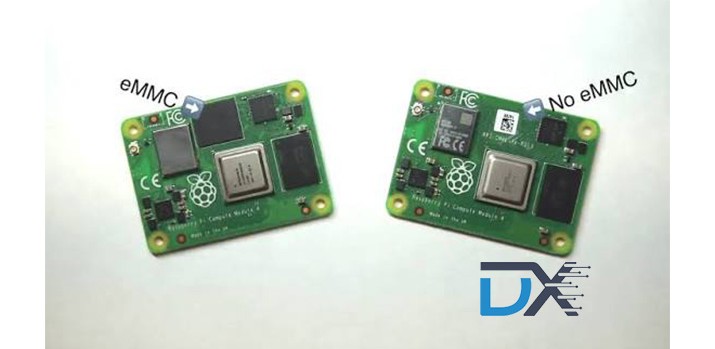
Single-Board Computers (SBCs): Provides built-in storage for operating systems and applications.
Robotics: Stores operating software, configuration data, and other system information.
Medical Devices: Can provide embedded storage for system software and device data.
Industrial HMIs and Controllers: NAND-based embedded storage can be used for system software, configuration data, historical information, and data logging.
3. Automotive Applications
Infotainment Systems: Stores operating software, applications, and other system data.
Telematics Systems: Provides embedded storage for system and communication-related data.
Instrument Clusters: Can be used to store system software and configuration information.
Automotive Embedded Systems: Automotive-grade eMMC products are available with temperature ranges and reliability characteristics designed for automotive environments.
eMMC Types
eMMC products can be grouped in different ways according to their intended application and design requirements. A common practical distinction is between consumer eMMCs and industrial eMMCs. The two types use the same basic eMMC concept, but their requirements for temperature, endurance, monitoring, reliability, and product lifecycle can be different.
Consumer eMMCs
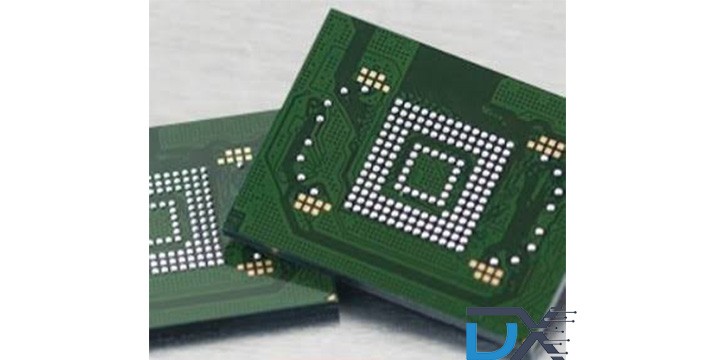
Consumer eMMCs are designed mainly for products such as smartphones, tablets, smart TVs, and other consumer electronics. They generally focus on balancing storage capacity, performance, power efficiency, and cost.
Their available capacities and operating specifications vary by manufacturer and product generation. For example, current eMMC product families can be offered in capacities ranging from several gigabytes to hundreds of gigabytes, depending on the specific product.
Industrial eMMCs
Industrial eMMCs are designed for applications that may require greater reliability, wider operating-temperature ranges, longer product lifecycles, and more detailed device monitoring. They are commonly used in industrial equipment, embedded systems, networking equipment, medical devices, and other applications where stable long-term operation is important.
Industrial eMMC specifications vary significantly between manufacturers and models. Some products provide wider temperature ratings, enhanced monitoring functions, and endurance-oriented configurations. Therefore, the exact capacity, temperature range, endurance, and monitoring functions should always be checked against the specific product datasheet.
Consumer eMMCs vs Industrial eMMCs Comparison Table
|
Feature |
Consumer eMMCs |
Industrial eMMCs |
|
Capacities |
Typically 4GB–256GB (mainstream mobile/consumer products) |
Typically 4GB–128GB (industrial-focused products prioritize stability over maximum density) |
|
Operating Temperature |
0°C to +70°C (typical commercial grade range) |
-40°C to +85°C (industrial grade range) |
|
SMART Monitoring |
Basic health indicators depending on eMMC version |
Extended monitoring depending on vendor implementation |
|
NAND Flash |
Commonly TLC or QLC NAND optimized for cost and density |
Typically MLC or high-endurance TLC NAND optimized for reliability and endurance |
|
Endurance |
Around 1,000–3,000 program/erase cycles (typical TLC-based consumer usage) |
Around 3,000–10,000+ program/erase cycles depending on NAND type and configuration |
|
Speed |
Up to HS400 mode (~400 MB/s theoretical interface bandwidth for eMMC 5.1) |
Same interface standards (up to HS400), but often tuned for sustained performance stability rather than peak speed |
|
Data Protection |
Standard features such as secure erase, secure trim, RPMB (model dependent) |
Enhanced reliability features such as power-loss protection strategies and stronger data integrity controls (implementation dependent) |
|
Lifecycle Support |
Typically 3–5 years product availability |
Typically 5–10+ years long-term supply and support |
|
Cost |
Lower cost per GB, optimized for mass consumer markets |
Higher cost due to extended temperature range, endurance, and long-term reliability requirements |
Frequently Asked Questions
What Does eMMC Mean and How Does It Work?
eMMC stands for Embedded Multi-Media Card and is an embedded storage solution that combines NAND flash memory and a controller in one package. The built-in controller manages functions such as error correction, wear leveling, and flash management, allowing the host processor to access storage through a standardized interface.
Is eMMC Still Found in Modern Electronic Devices?
Yes, eMMC is still used in modern electronic devices, especially products with moderate storage and performance requirements. It can be found in devices such as tablets, personal computers, smart TVs, portable devices, and other embedded systems
What Are the Main Differences Between eMMC and SSD Storage?
Both eMMC and SSD storage use NAND flash memory, but their designs and applications are different. eMMC integrates NAND flash and its controller into a compact package for embedded systems, while SSDs are generally independent storage devices designed for higher-capacity and higher-performance storage applications.
How Long Can an eMMC Device Typically Last?
There is no fixed lifespan for all eMMC devices because service life depends on factors such as NAND type, write frequency, storage capacity, workload, and operating conditions. eMMC uses functions such as wear leveling to distribute write and erase cycles across NAND blocks, while manufacturers recommend evaluating lifetime according to the specific device and application.
How Can I Check Whether My Device Uses eMMC?
You can usually check your device's storage specifications or system information to identify the type of storage it uses. If the specifications list eMMC or Embedded Multi-Media Card as the storage type, the device uses eMMC; otherwise, the exact storage type may need to be confirmed through the manufacturer's specifications or technical documentation.


