

Introduction
GDDR, or Graphics Double Data Rate, is a type of high-speed memory designed mainly for graphics processors (GPUs). It stores data that the GPU needs for tasks such as rendering images, processing video, gaming, and other data-intensive workloads.
GDDR technology has developed through several generations, with each generation improving data rate, memory bandwidth, power efficiency, and memory architecture.
GDDR5, GDDR6, and GDDR7 represent three important generations, and this article compares their architecture, speed, bandwidth, power consumption, and typical applications.
GDDR5 Overview
GDDR5 is a graphics memory standard developed for high-speed graphics applications and became widely used from around 2008. Major memory manufacturers, including Micron, Samsung, and SK hynix.
GDDR5 can reach data rates of up to 8 Gb/s per pin and uses an 8n prefetch architecture, making it much faster than earlier mainstream GDDR generations.
Clamshell Mode
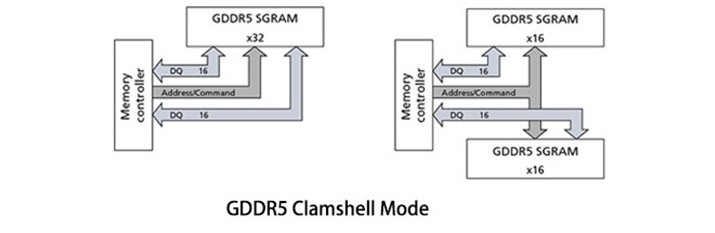
GDDR5 Clamshell Mode is a memory configuration that allows two GDDR5 memory devices to share the same memory channel. It can increase the total memory capacity without requiring a wider memory bus. This mode is useful when a graphics system needs more memory capacity while keeping the existing memory interface.
Memory Architecture
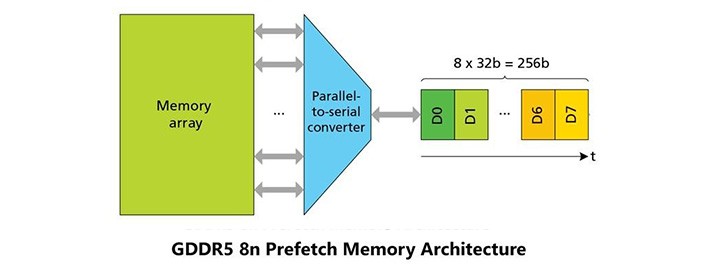
GDDR5 uses a 32-bit memory interface per device and an 8n prefetch architecture. Its architecture is designed to transfer a large amount of data efficiently while keeping the memory interface suitable for high-speed graphics applications.
Data Rate
GDDR5 supports data rates from around 2 Gb/s to 8 Gb/s per pin, depending on the device. Its higher data rate allows more data to move between the memory and GPU in a given amount of time.
Memory Bandwidth
The main factors affecting GDDR5 memory bandwidth include:
- Per-pin data rate
- Memory bus width
- Number of memory devices
- GPU memory configuration
A GDDR5 memory device with an 8 Gb/s data rate and a 32-bit interface can provide up to about 32 GB/s of theoretical bandwidth.
Speed
GDDR5 can reach data rates of up to 8 Gb/s per pin. Compared with earlier GDDR generations, it provides higher transfer speed and better bandwidth for graphics processing. The actual speed of a GDDR5 product depends on its specific design and manufacturer.
Voltage and Power Efficiency
GDDR5 commonly operates at 1.5V, while some products support a lower 1.35V operating voltage. Compared with earlier generations, this helped reduce power consumption while maintaining higher data rates. However, GDDR5 is less power-efficient than newer GDDR6 and GDDR7 memory.
GDDR6 Overview
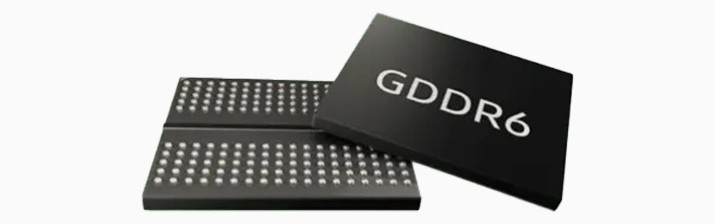
GDDR6 is the successor to GDDR5 and was introduced to provide higher bandwidth and better power efficiency for modern graphics systems. It became commercially important around 2018, with major manufacturers such as Micron, Samsung, and SK hynix producing GDDR6 memory. GDDR6 supports higher data rates and uses a dual-channel architecture inside each memory device.
Clamshell Mode
GDDR6 can also support a configuration in which two memory devices operate on a single channel. This approach can be used to increase memory capacity without simply increasing the width of the GPU memory bus. It provides greater flexibility when designing graphics memory systems.
Memory Architecture
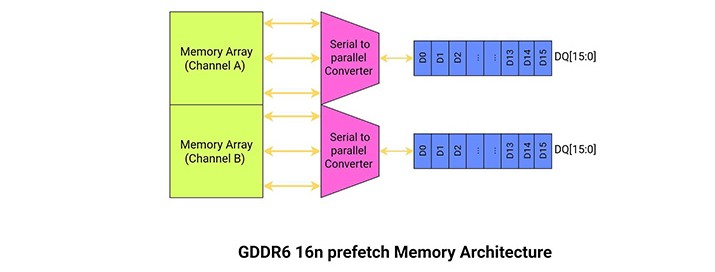
GDDR6 uses two independent 16-bit channels within a 32-bit device interface. This is an important architectural change from GDDR5 and allows the memory controller to access the two channels more flexibly.
GDDR6 also uses a 16n prefetch architecture, which is twice the prefetch depth of GDDR5. This helps GDDR6 achieve higher data rates while maintaining an efficient internal memory design.
Data Rate
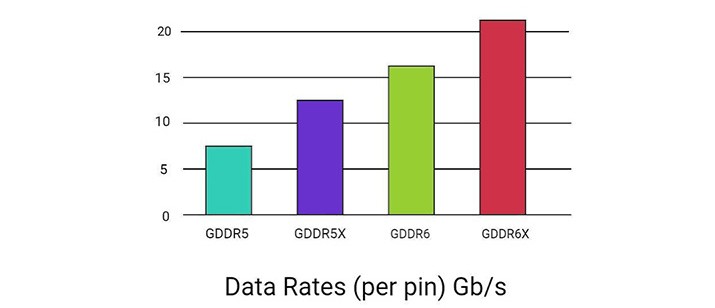
GDDR6 products initially supported data rates around 14 Gb/s per pin, while later products reached 16 Gb/s and beyond. This higher data rate allows GDDR6 to provide substantially more data throughput than GDDR5.
Memory Bandwidth
GDDR6 memory bandwidth is the theoretical amount of data that can be transferred per second between the GPU and GDDR6 memory, typically reaching up to about 72 GB/s per 32-bit device at 18 Gb/s, depending mainly on the data rate and the width of the GPU memory bus.
Speed
GDDR6 initially reached about 14 Gb/s per pin, with later products supporting 16 Gb/s, 18 Gb/s, and other higher-speed configurations. Compared with GDDR5's 8 Gb/s maximum in Micron's comparison data, GDDR6 can provide significantly higher transfer rates.
This higher speed makes GDDR6 suitable for high-resolution gaming, professional graphics, networking, AI acceleration, and other applications that require high memory throughput.
Power Consumption
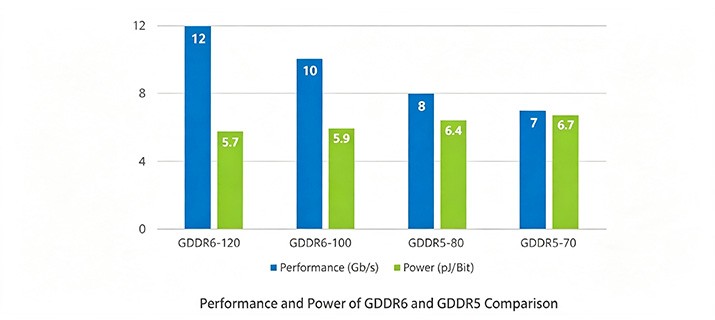
GDDR6 commonly operates at 1.35V, with some products supporting a lower 1.25V voltage. This is lower than the 1.5V commonly used by GDDR5.
As a result, GDDR6 can provide higher performance while improving power efficiency compared with GDDR5. The actual power consumption still depends on the memory speed, workload, device design, and operating conditions.
GDDR7 Overview
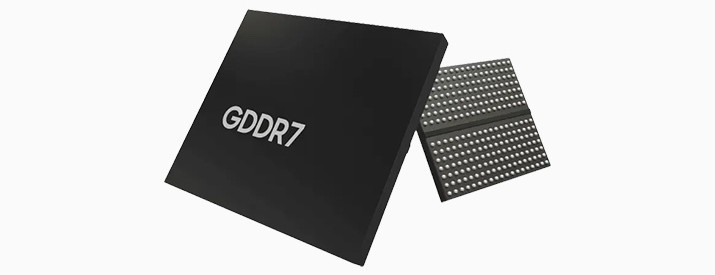
GDDR7 is a newer generation of high-performance graphics memory designed for demanding applications such as gaming, AI, and high-performance computing. The first generation of GDDR7 products reached data rates of up to 32 Gb/s per pin, and Micron began sampling GDDR7 in 2024.
One of the most important changes in GDDR7 is the use of PAM3 signaling instead of the NRZ signaling used by GDDR6. This allows GDDR7 to increase data transfer performance while improving power efficiency.
Memory Architecture
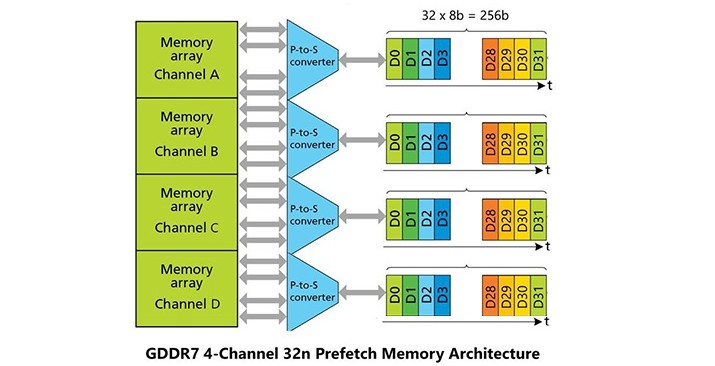
GDDR7 uses a more advanced memory architecture with four independent channels in a 32-bit device. This provides more flexible access to memory data compared with the two-channel structure of GDDR6.
GDDR7 also uses a deeper prefetch architecture and introduces additional reliability features such as on-die ECC, CA parity, and CRC. These improvements are designed to support higher speeds while maintaining data reliability.
Data Rate and Memory Bandwidth
The first-generation GDDR7 specification supports data rates of up to 32 Gb/s per pin. This is a major increase compared with the 18 Gb/s maximum shown for GDDR6 in Micron's GDDR6/GDDR7 comparison.
A Micron GDDR7 device with a 32-bit interface and 32 Gb/s per-pin data rate can provide up to 128 GB/s of bandwidth per component.
Speed
GDDR7 can reach up to 32 Gb/s per pin in the first-generation products described by Micron. This is significantly higher than the 18 Gb/s maximum listed for GDDR6 in the same comparison.
The increase is not achieved simply by increasing the clock frequency. GDDR7 uses PAM3 signaling, which allows more information to be transferred efficiently and helps the technology continue scaling to higher data rates.
Voltage and Power Efficiency
GDDR7 reduces the operating voltage to around 1.2V in Micron's first-generation product, compared with 1.35V for GDDR6. This lower voltage helps improve power efficiency while supporting much higher data rates.
Micron reports that GDDR7 can provide more than 50% better power efficiency compared with GDDR6 in its product information. GDDR7 also includes power-saving functions such as sleep modes and partial device operation.
GDDR5, GDDR6, GDDR7 Comparison
Each new GDDR generation introduces improvements in speed, bandwidth, architecture, and power efficiency. In general, GDDR5 focuses on high-speed graphics memory, GDDR6 increases bandwidth and improves efficiency, while GDDR7 is designed for much higher data rates and more demanding workloads.
GDDR5, GDDR6, and GDDR7 are not directly interchangeable. A GPU must use a memory controller designed for the specific GDDR generation. GDDR7, for example, uses PAM3 signaling and requires a new memory controller, so it is not backward compatible with GDDR6 or GDDR6X.
GDDR5 vs GDDR6 vs GDDR7 Comparison Table
|
Feature |
GDDR5 |
GDDR6 |
GDDR7 |
|
Full Name |
Graphics Double Data Rate 5 |
Graphics Double Data Rate 6 |
Graphics Double Data Rate 7 |
|
Release Date |
Around 2008 |
Around 2018 |
2024 |
|
Density |
512Mb–8Gb |
8Gb–16Gb |
16Gb in first-generation Micron products |
|
Voltage |
1.5V; some 1.35V |
1.35V; some 1.25V |
1.2V |
|
Bandwidth |
Up to about 32 GB/s per 32-bit device at 8 Gb/s |
Up to about 72 GB/s per component at 18 Gb/s |
Up to 128 GB/s per component at 32 Gb/s |
|
Burst Length |
8 |
16 |
32n prefetch architecture |
|
Prefetch |
8n |
16n |
32n |
|
Speed |
Up to 8 Gb/s per pin |
Up to 18 Gb/s in referenced products |
Up to 32 Gb/s per pin in first-generation products |
|
Power Efficiency |
Lower than newer generations |
Better than GDDR5 |
More than 50% better than GDDR6 in Micron's comparison |
|
Per-pin Data Rate |
Up to 8 Gb/s |
Up to 18 Gb/s |
Up to 32 Gb/s |
|
Cost |
Generally lower due to mature technology |
Generally higher than GDDR5 |
Generally higher than older GDDR generations |
|
Typical Applications |
Older graphics cards, gaming, multimedia |
Graphics cards, game consoles, networking, AI/HPC acceleration |
High-end graphics, AI, HPC, advanced gaming |
How to Choose Between GDDR5, GDDR6, and GDDR7
Choosing between GDDR5, GDDR6, and GDDR7 depends on the required performance, power efficiency, system compatibility, application, and overall cost.

Performance requirement
GDDR5 provides adequate bandwidth for older or less demanding graphics applications.
GDDR6 offers much higher data rates and is suitable for modern graphics and other bandwidth-intensive workloads.
GDDR7 provides the highest performance of the three and is better suited to demanding gaming, AI, and high-performance computing applications.
Power efficiency
GDDR5 generally requires more operating voltage than newer generations.
GDDR6 reduces operating voltage while increasing performance.
GDDR7 goes further by using a 1.2V operating voltage in the referenced Micron products and adding power-saving features, making it the most power-efficient option among the three in this comparison.
Memory bandwidth
GDDR5 provides lower bandwidth and is suitable for systems with moderate memory bandwidth requirements.
GDDR6 offers a significant bandwidth improvement and is a practical choice for many modern graphics systems.
GDDR7 provides substantially higher bandwidth and is designed for workloads where memory throughput is a major performance limitation.
Cost and system design
GDDR5 can be attractive when cost and existing hardware are the main concerns, although its availability and suitability for new designs may be limited.
GDDR6 offers a balance between performance, power efficiency, availability, and cost.
GDDR7 generally represents a higher-end solution and requires a compatible GPU and memory controller, so it is better suited to new systems designed around its higher performance.
Application
GDDR5 is mainly relevant to older graphics and multimedia systems.
GDDR6 is widely suitable for graphics cards, game consoles, networking equipment, AI acceleration, and high-performance computing.
GDDR7 is designed for newer high-performance GPUs and demanding workloads such as advanced gaming, AI inference, and HPC.
Frequently Asked Questions
How Does GDDR7 Differ from GDDR6 Memory?
GDDR7 is the newer generation of graphics memory and offers higher data rates and memory bandwidth than GDDR6. It also introduces PAM3 signaling and a four-channel architecture, while GDDR6 uses NRZ signaling and two 16-bit channels.
Can a GDDR6 GPU Work on a GDDR5 Motherboard?
A GPU with GDDR6 memory can generally be installed on a motherboard that supports the required graphics-card interface, such as PCIe, because the GPU's GDDR6 memory is separate from the motherboard's system memory.
However, if by “GDDR5 motherboard” you mean a motherboard designed specifically for GDDR5 system memory, GDDR5 and GDDR6 are not interchangeable memory technologies, and compatibility depends on the specific GPU and motherboard interfaces.
What Data Speeds Can GDDR6 Memory Reach?
GDDR6 supports different data rates depending on the specific product, with common versions operating at around 14–18 Gb/s per pin. Some newer GDDR6 implementations can reach 20 Gb/s or beyond, so the actual speed depends on the memory device and graphics card design.
Is GDDR6 Memory Suitable for Gaming?
Yes, GDDR6 is well suited for gaming because it provides high data rates and memory bandwidth for graphics processing. It is widely used in modern graphics cards and game consoles, where high memory bandwidth is important for high-resolution rendering and demanding games.
Can GDDR6 and GDDR5 Memory Be Used Interchangeably?
No, GDDR6 and GDDR5 are different generations of graphics memory and are not directly interchangeable. They use different memory architectures and interfaces, so a GPU and its memory controller must be designed to support the specific GDDR generation being used.


